About DPOR
Go to the Regulant Population List for the most recent number of regulated individuals/businesses by license type.
Who We Are
DPOR is an executive branch agency that oversees 18 regulatory boards and programs. Our regulatory boards, plus the Board for Professional and Occupational Regulation (BPOR), are comprised of practitioners and citizens appointed by the governor, and are responsible for regulating certain professions and occupations, as determined by the General Assembly. Our 200 employees serve more than 325,000 individuals and businesses across several hundred license types, ranging from architects and contractors to cosmetologists and professional wrestlers. View the DPOR one-pager.
What We Do
DPOR issues professional credentials—licenses, certificates or registrations—in the least intrusive, least burdensome and most efficient way. Our goal is to ensure the minimum competency necessary to practice without harming the public, not to enhance professional stature or limit competition by keeping newcomers out. Policy boards determine the minimum standards necessary to enter a profession, and qualify applicants based on a combination of education, experience and examination.
DPOR also enforces standards of professional conduct. The agency investigates reports of regulatory violations and seeks to obtain compliance with the law or, when necessary, to discipline the licensee. Regulatory board sanctions against licensees include fines, probationary terms, suspension or license revocation.
Unlicensed activity—practicing a profession without a required state license—is a misdemeanor criminal violation. Regulatory boards do not have jurisdiction over unlicensed individuals. In cases involving allegations of unlicensed practice, DPOR attempts to obtain compliance with licensing requirements or works with local law enforcement to assist in bringing criminal charges. Ultimately, unlicensed activity is outside the boards' legal jurisdiction and prosecution is at the discretion of local officials.
Why We Do It
DPOR strives to promote a positive business climate, ensure a competent workforce and provide exceptional customer service. As an executive branch agency under the Secretary of Labor, we support Virginia's economic vitality by helping qualified people start businesses and work in their chosen fields. We protect the public by verifying minimum competency, investigating complaints, and upholding professional compliance with state law and regulations.
How We Do It
As a non-general fund agency, DPOR is financed solely by revenue collected through fees paid by licensees, not by tax revenues (general funds). Fees are adjusted periodically, as required by the "Callahan Act" (§ 54.1-113 of the Code of Virginia), to ensure revenues are sufficient to cover expenses, but not excessive.
DPOR operates in full view of the public and welcomes participation by licensees, consumers and all Virginians. All board meetings are announced in advance and open to the public, and board actions are reflected in the meeting minutes—all available online at the Virginia Regulatory Town Hall.
Agency operations are governed by the Administrative Process Act (APA), which provides opportunities for public comment on proposed regulations as well as due process protections for licensees. The APA's three-stage process provides elected officials, businesses, individuals, and other interested parties ample opportunity to study proposed changes and provide comments.
Our Mission
The Department of Professional and Occupational Regulation protects the health, safety and welfare of the public by licensing qualified individuals and businesses and enforcing standards of professional conduct for professions and occupations as designated by statute.
Our Vision
The Department of Professional and Occupational Regulation will be the Commonwealth’s most effective agency, discovering creative ways to integrate regulatory efficiency with consumer protection via a commitment to exceptional customer service, efficient business processes, technological proficiency, and empowered employees.
Our Values
.png)
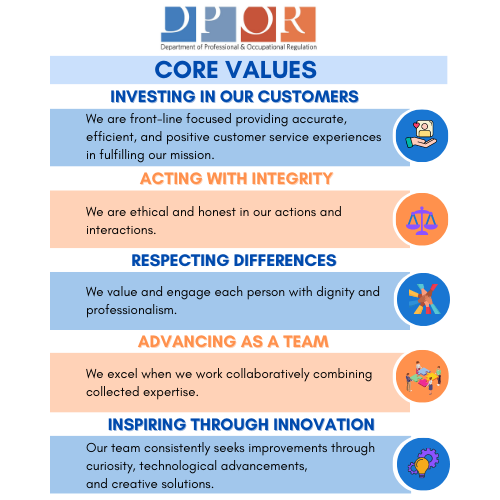
Investing in Our Customers
We are the front-line focused providing accurate, efficient, and positive customer service experiences in fulfilling our mission.
Acting with Integrity
We are ethical and honest in our actions and interactions.
Respecting Differences
We value and engage each person with dignity and professionalism.
Advancing as a Team
We excel when we work collaboratively combining collected experience.
Inspiring through Innovation
Our team consistently seeks improvements through curiosity, technological advancements, and creative solutions.
Agency History - DPOR Timeline of Regulatory Programs
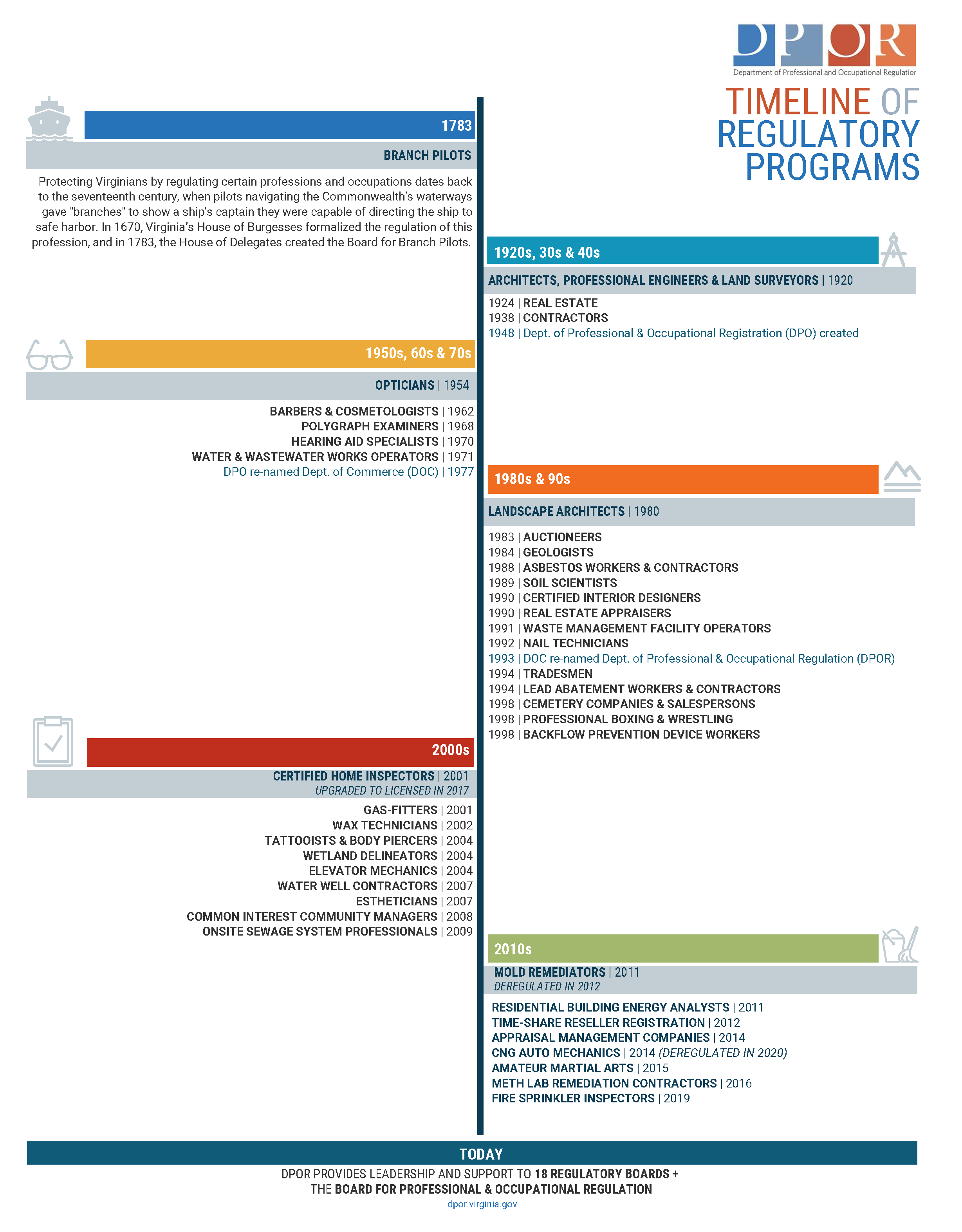
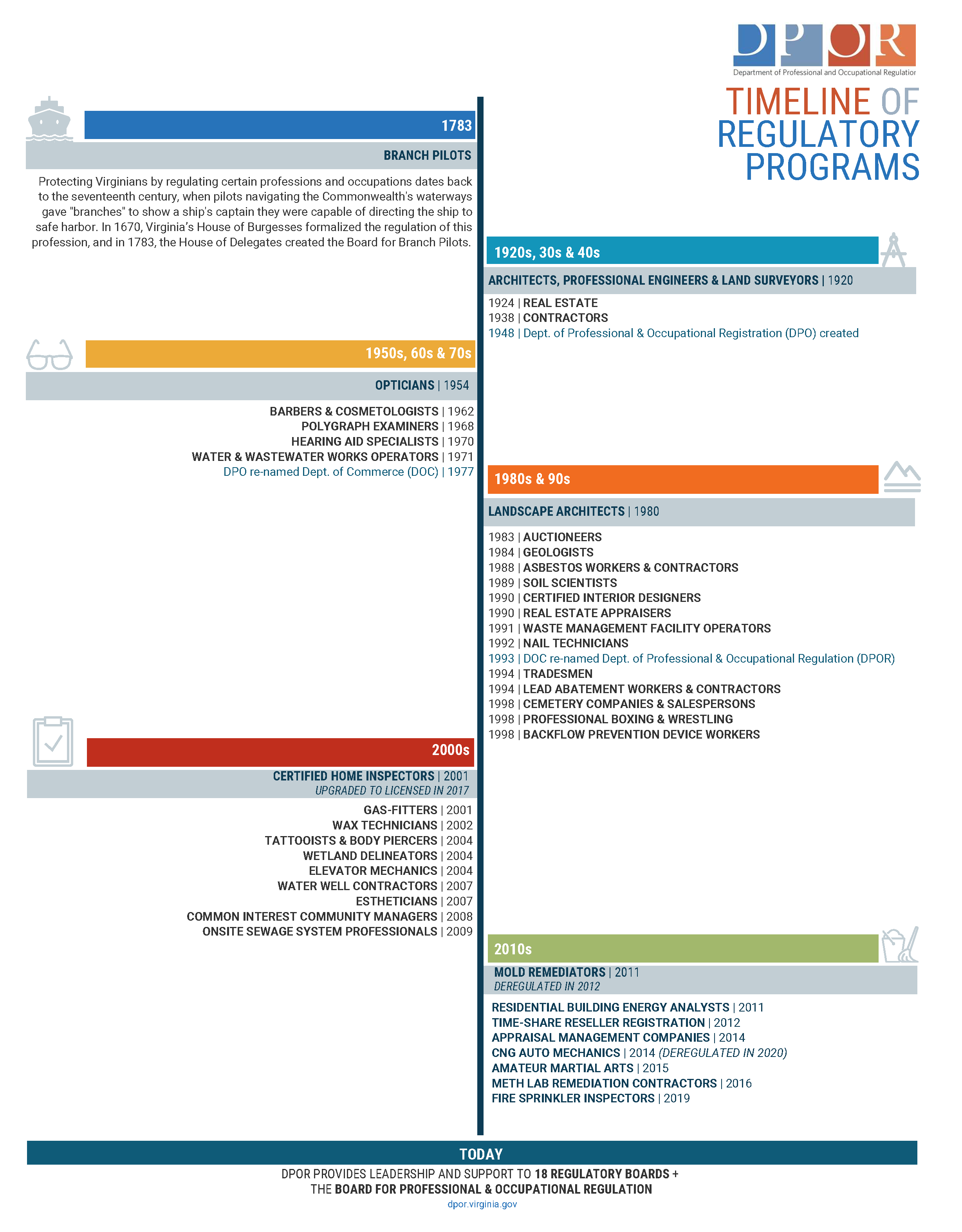
A timeline of DPOR's regulatory programs. In 1783, the Branch Pilots board was created. Between 1920-1940, the Architects/Professional Engineers/Land Surveyors, Real Estate, and Contractors professions were added. Between 1950-1970, the Opticians, Barbers and Cosmetology, Polygraph Examiners, Hearing Aid Specialists, and Water/Wastewater Works professions were added. Between 1980-1990, the Auctioneers, Geologists, Asbestos Workers and Contractors, Soil Scientists, Certified Interior Designers, Real Estate Appraisers, Waste Management Facility Operators, Nail Technicians, Tradesmen, Lead Abatement Workers and Contractors, Cemetery Companies/Salespersons, Boxing and Wrestling, and Backflow Prevention Device Workers professions were added. Throughout the early 2000's, Gas Fitters, Wax Technicians, Tattooists and Body Piercers, Wetland Delineators, Elevator Mechanics, Water Well Contractors, Estheticians, Common Interest Community Managers, and Onsite Sewage System professions were added. In 2010 and beyond, Mold Remediators (deregulated in 2012), Residential Building Energy Analysts, Time-share Resellers, Appraisal Management Companies, CNG Auto Mechanics, Amateur Martial Artists, Meth Lab Remediation Contractors, and Fire Sprinkler Inspectors professions were added. Today, DPOR provides leadership and support to 18+ regulatory boards - The Department of Professional and Occupational Regulation.